Getting Started
Classic
Logging into your Placester Account [Classic]
Requesting an IDX Integration [Classic]
Editing Your Contact Details [Classic]
Changing Themes and Colors [Classic]
Adding Images to your Home Slideshow [Classic]
Adding a Favicon [Classic]
Linking Social Networks [Classic]
Adding Certification Logos to the Footer of your Site [Classic]
Changing your Global filter settings [Classic]
Using Basic Lead Capture [Classic]
Creating a Blog Post [Classic]
Creating Advanced Area Pages and an Area Page Index [Classic]
Creating a Page [Classic]
Adding a Logo [Classic]
Codeless
Getting Started Checklist
Logging into your Placester Codeless Account [Codeless]
Requesting an IDX Integration [Codeless]
Image Dimension Guide [Codeless]
Changing your Global filter settings [Codeless]
Editing Your Codeless Contact Details [Codeless]
Adding Images to your Home Slideshow [Codeless]
Featuring Listings on your Home Page [Codeless]
Adding Certification Logos to the Footer of your Codeless Website [Codeless]
Adding a Favicon [Codeless]
What is Codeless?
Updating Classic to Codeless Website
Non IDX Website
Social Feed ( Codeless )
Notification System in the Admin Panel
How to add JS Code to your Placester Website ( Codeless )
The Codeless Design Library and Design Switching
Ordering a Simple Service or a DIFM Task
Service Marketplace Credit
What Is Services?
Following a Project in Services
Messaging Your Creative Assistant and Sending Files
Placester's Web App
All Things IDX
Classic
TREC Requirements [Classic]
RightSignature Cheat Sheet
Adding Your License Number to Your Site [Classic]
Adding Multiple IDX feeds to your site [Classic]
Map Search [Classic]
Natural Language Search [Classic]
Selecting Search Forms [Classic]
Featuring Listings on your Home Page [Classic]
Basic Areas and Creating an Areas Index Page [Classic]
How Placester Handles 1/4, 1/2 and 3/4 Baths [Classic]
Codeless
How to fill out your IDX Documents on RightSignature.com
IDX Process: FAQ's
TREC Requirements [Codeless]
MLS Recommendations/ Updates
IDX Manager [Codeless]
Customizer: Requesting an IDX Integration [Codeless]
Adding Multiple IDX feeds to your site [Codeless]
What Is Upgraded Property Search?
IDX Support Fee
How to Enable Upgraded Property Search on Your Website?
IDX Integration Removal
Setting Priority on Listings
Account, Subscription & Billing
Codeless
Updating Account Email
Placester Mobile App
Hiring a Creative Assistant Using On-Demand
Account Reactivation
Plan and Billing: Invoices & Accessing the Usage Trail
Understanding and Updating Your Business Profile
Updating Payment Details
How to Capture Leads
Customizing your Website
Classic
Custom Domain
How and Where to Purchase a Custom Domain
Pointing your Custom Domain to your Placester Site [Classic]
Editing your Placester Subdomain [Classic]
Forwarding Additional Domains to Your Website [Classic]
Mapping Your GoDaddy Domain to Placester (New User Interface) [Classic]
Mapping your Network Solutions domain to Placester [Classic]
Mapping your Register.com domain to Placester [Classic]
Mapping your Wix Domain to Placester [Classic]
Mapping your iPage Domain to Placester [Classic]
Mapping your Domain.com domain to Placester [Classic]
Mapping your Bluehost Domain to Placester [Classic]
Mapping your Name.com Domain to Placester [Classic]
Mapping your HostGator domain to Placester [Classic]
Mapping Your Domain vs. Forwarding With Masking [Classic]
Mapping your .REALTOR Domain to Placester [Classic]
Mapping your eNom domain to Placester [Classic]
Common Domain Mapping Issues & How to Resolve Them [Classic]
Mapping your DreamHost domain to Placester [Classic]
Mapping your Google Domain to Placester [Classic]
Mapping your Hover domain to Placester [Classic]
Mapping your Namecheap domain to Placester [Classic]
Mapping a Subdomain to your Placester Site [Classic]
Pages, Menus & Posts
Using the Featured Listings Page Template [Classic]
Editing an Existing Blog Post [Classic]
Adding Photos to Pages and Posts [Classic]
Editing Your Menu [Classic]
Adding Featured Content Tiles [Classic]
Adding a blog post to a category [Classic]
Scheduling Blog Posts [Classic]
Choosing Testimonial Featured images [Classic]
Page Templates [Classic]
Editing an Existing Page [Classic]
Using Formatting Options on Pages and Posts [Classic]
Adding Videos to Pages and Posts [Classic]
Advanced Page Editing [Classic]
Creating a coming soon page [Classic]
Adding HTML to a Page [Classic]
Adding a Menu Item that links to a Custom URL [Classic]
What to Include in your About page [Classic]
Home Valuation Page [Classic]
Creating a Custom Landing Page [Classic]
Creating a Testimonials Page [Classic]
Theme Guides
Sedona Theme Guide [Classic]
Chicago Image Dimension Guide [Classic]
Franklin Theme Guide [Classic]
Toronto Theme Guide [Classic]
Phoenix Theme Guide [Classic]
Beacon: Image Dimension Guide [Classic]
Wilshire: Image Dimension Guide [Classic]
Plymouth Image Dimensions Guide [Classic]
How Many Featured Listings and Blog Posts Are Displayed on Each Theme's Home Page? [Classic]
Fremont Theme Guide [Classic]
Highland Image Dimensions Guide [Classic]
Newbury: Image Dimension Guide [Classic]
Recommended Logo Sizes for Each Theme
Lexington: Image Dimension Guide [Classic]
Best Practices
What Should My Slideshow Captions and Links Be? [Classic]
What's Important To Feature In Your Menu [Classic]
Adding your Google Analytics Tracking Code [Classic]
Adding your Google AdWords Conversion Label and ID [Classic]
Adding a Video Link to Your Home Slideshow [Classic]
What To Do After Your Site Is Live [Classic]
How and Why to Add Excerpts to Pages [Classic]
Adding a Facebook Pixel to your Placester Site [Classic]
Submitting your Sitemap to Google
Site Verification for Google, Pinterest, and Bing [Classic]
Adding a Meta Description & Meta Title to your Home Page [Classic]
Adding a Meta Title & Meta Description to Pages and Posts [Classic]
Pro Tips
Writing Your First Blog Post [Classic]
How to Embed a Google Calendar onto your Placester Site [Classic]
Selecting Great Slideshow Images and Where to Find Them [Classic]
How To Create a "Join our Team" Page [Classic]
How to Use Social Networks for Real Estate [Classic]
Adding Social Networks ( Classic)
Which Lead Capture Setting is Best For You? [Classic]
How to optimize SEO on your Placester Site
Removing "For Rent" From Your Search Bar [Classic]
Tips and Resources for Cropping and Resizing Images [Classic]
Sharing Blog Posts on Social Media [Classic]
How to Clear Your Cache [Classic]
How Can I Drive Traffic To My Site?
Account
Codeless
Pages, Menu and Posts
Using Featured Listings Page Template [Codeless]
Creating Advanced Area Pages and an Area Page Index [Codeless]
Creating a Testimonials Page [Codeless]
Managing Property Details Page
Integrating Your Real Satisfied Account [Codeless]
Creating new testimonial [Codeless]
Accessibility Widget [Codeless]
Open Houses- Module, Widget and Page Template
Adding a Menu Item that links to a Custom URL [Codeless]
Scheduling Blog Posts [Codeless]
Home Valuation Page [Codeless]
How to create an About Page [Codeless]
Adding Modules to Pages, Areas, Agents, Blog post, Offices and Testimonials
Create and Manage Agent Groups in your Agent Index page
Custom pages for recent sales/open houses (Codeless)
Market Data on Area Pages
Sold Listings
How To Hyperlink Text And Images
Adding a Blog Post to a Category [Codeless]
Advanced Page Editing [Codeless]
Map Search ( Codeless)
Codeless Coming Soon Listing Page [Codeless]
Creating a Custom Landing Page [Codeless]
Choosing Testimonial Featured images [Codeless]
Editing an Existing Blog Post [Codeless]
Adding a Button to a Page [Codeless]
Creating a Contact Page ( Codeless )
Property Landing Page
Editing Your Navigation Bar [Codeless]
Using Formatting Options on Pages and Posts [Codeless]
Adding Your Facebook App ID [Codeless]
Switching Website Design [Codeless]
Adding Featured Content Tiles [Codeless]
Page Templates [Codeless]
Tips and Resources for Cropping and Resizing Images [Codeless]
Custom Domain
How and Where to Purchase a Custom Domains [Codeless]
Common Domain Mapping Issues & How to Resolve Them [Codeless]
Pointing your Custom Domain to your Placester Site [Codeless]
Forwarding Additional Domains to Your Website [Codeless]
Mapping Your Domain vs. Forwarding With Masking [Codeless]
Editing your Placester Subdomain [Codeless]
Nameservers vs DNS Settings
Mapping your HostGator domain to Placester [Codeless]
Mapping your Register.com domain to Placester [Codeless]
Mapping your DreamHost domain to Placester [Codeless]
Mapping your iPage Domain to Placester [Codeless]
Mapping your Domain.com domain to Placester [Codeless]
Mapping your Hover domain to Placester [Codeless]
Mapping your Google Domain to Placester [Codeless]
Mapping your Network Solutions domain to Placester
Mapping your Wix Domain to Placester [Codeless]
Mapping a Subdomain to your Placester Site [Codeless]
Mapping your Name.com Domain to Placester [Codeless]
Mapping your .REALTOR Domain to Placester [Codeless]
Mapping your Namecheap domain to Placester [Codeless]
Mapping your eNom domain to Placester [Codeless]
Mapping your Bluehost Domain to Placester [Codeless]
Mapping your CloudFlare domain to Placester [Codeless]
Font Style and Size
Leveraging Placester's Simple CRM
Classic
Viewing and Editing Leads
Manually Adding a Lead [Classic]
Removing a Lead [Classic]
Editing your Leads individually and through Bulk Actions [Classic]
Viewing Your Leads [Classic]
Lead Management
Exporting Leads [Classic]
Managing Duplicate Leads [Classic]
What Can Site Visitors Do With an Account? [Classic]
CRM: Managing Custom Views [Classic]
Creating Saved Searches for your Leads [Classic]
Routing Leads From Other Sources to Your Placester Account
Importing Leads [Classic]
How to Add Tags to Leads and Contacts [Classic]
Creating Groups
Adding a Note to a Lead [Classic]
Creating / Managing Tasks (In Leads) [Classic]
How Leads Can Create Saved Searches [Classic]
Using Plans
Creating a Custom Signature [Classic]
Editing a Plan Email Template [Classic]
Creating and Managing Your Email Blasts [Classic]
Editing a Plan [Classic]
Adding single or multiple leads to a plan [Classic]
Creating a New Email Template [Classic]
Creating a New Drip Campaign [Classic]
Broker Features
Codeless
Viewing Your Leads [Codeless]
4.0 Editing your Leads individually and through Bulk Actions [Codeless]
Manually Adding a Lead [Codeless]
4.0 Removing a Lead [Codeless]
Importing Leads [Codeless]
Managing Duplicate Leads [Codeless]
Exporting Leads [Codeless]
4.0 Adding a Note to a Lead [Codeless]
How to Add Tags to Leads and Contacts [Codeless]
Creating Saved Searches for your Leads [Codeless]
How Leads Can Create Saved Searches [Codeless]
Editing a Plan [Codeless]
Creating a New Email Template [Codeless]
Adding single or multiple leads to a plan [Codeless]
Autoresponders
Creating and Managing Your Email Blasts [Codeless]
Creating a New Drip Campaign [Codeless]
What Can Site Visitors Do With an Account? [Codeless]
CRM: Managing Custom Views [Codeless]
New Placester CRM
SEO Capabilities
Codeless: Manual assigning of Leads to Agents
Creating a Custom Signature [Codeless]
Setting up Integrations
Classic
Codeless
Accessing RealSatisfied Account
Linking Social Networks [Codeless]
What is Zapier?
How to Integrate Your Placester Account With Zapier
Integrating Your Local Logic Account
Cloze- Placester Integration
Follow Up Boss - Placester Integration
Integration: Custom API
TotalBrokerage - Placester Integration
Advanced Website Customization
Classic
Lead Text Notifications Using Gmail [Classic]
Embedding A PDF or File To A Page [Classic]
Custom pages for recent sales/open houses [Classic]
Adding a GIF To Your Home Slideshow [Classic]
Tricks for Speeding up a Slow Website [Classic]
Adding Facebook Messenger to your site [Classic]
Adding a Chat Widget to Your Site [Classic]
Adding a Google Maps location to your Contact page [Classic]
Adding a Logo to Your Site's Footer [Classic]
Adding Google Tag Manager [Classic]
Codeless
Search: Autosuggest Results
Placester Live Chat Feature
Embedding A PDF or File To A Page [Codeless]
Adding Google Tag Manager (Codeless)
Site Verification for Google, Pinterest, and Bing [Codeless]
Lead Text Notifications Using Gmail [Codeless]
Adding Animations to Your Design Modules in Codeless
Overlay management
Custom Property Page Banner
How to Resize and Crop Headshots [Codeless]
Custom Banner
Sign In/ Sign Up Forms
Cookie Banner
Advanced Broker Customization
Classic
Creating an Agents Page [Classic]
Creating an Agents Roster Page on Your Office Site [Classic]
How To Order Agents within your Agent Index Page [Classic]
Creating an Office Page using Customizer [Classic]
Codeless
Other Topics
Compliance
Customizer
Customizer: Creating a Blog Post [Codeless]
Adding a Facebook Pixel to your Placester Site (Codeless)
Customizer: Adding your Google Analytics Tracking ID, AdWords Conversion Label and ID [Codeless]
Customizer: Using Custom Lead Capture[Codeless]
Customizer: Adding a Chat Widget to Your Site [Codeless]
Customizer: Editing an Existing Page [Codeless]
Customizer: Mapping your GoDaddy Domain to Placester [Codeless]
Leveraging Video Modules on Your Codeless Website
How to add your Logo to the Header & Footer [Codeless]
Customizer: Adding HTML to a Page [Codeless]
Customizer: Creating a New Page [Codeless]
Customizer: Adding a Meta Description & Meta Title to your Home Page [Codeless]
Defining Modules and Widgets in Codeless
How to Setup Modules, Manage their Options, and Build Module Presets [Codeless]
Customizer: Adding Photos to Pages and Blog Posts [Codeless]
Customizer: Adding Videos to Pages and Posts [Codeless]
Agent Manager (Office Builder)
Site Editor
Embedding HTML, Forms, and Files
Publishing and Discarding Drafts
Creating Area Pages and an Areas Index
Setting Up Redirects and Your 404 Page
Adding Video to Your Site
Organizing Blog Posts with Categories
Adding Compliance Pages and Footer Links
Editing Your Header, Top Bar, Logo and Footer
Editing Content on the Page
Turning On the Cookie Banner and Accessibility Widget
Creating a Property Landing Page
Creating a Lead Capture Popup
Using the Search Box in Site Edit
Customizing Your Search Results Page
Creating a Blog Post
Linking Your Social Networks
Why Isn't My Change Live?
Adding Testimonials and a Testimonials Page
Adding a Custom Banner
Customizing Property Detail Pages
Module Types Reference
Creating a Custom Landing Page
Editing an Existing Page
Showing Your Agents on Your Website
Scheduling a Blog Post
Editing Your Homepage Hero and Slideshow
Setting Up Placester Live Chat
Formatting Text, Links, Images, and Tables
Getting Started with Site Edit
Using the Media Library
Choosing Which Listings Appear on Your Site
Page and Post SEO
Showing Open Houses, Recent Sales and Coming-Soon Listings
Adding Tracking Codes and Custom Code
Choosing a Page Type
Updating Your Contact and Office Details
Creating a New Page
Uploading, Cropping and Sizing Images
Site Design and Branding
Working with Modules
Editing an Existing Blog Post
Updating Your Site Title, Tagline, and Favicon
Setting Up AI Listing Search
Verifying Your Site with Google, Bing, and Pinterest
Editing Your Navigation Menu
Adjusting Heading Typography
Switching Your Site Design
Adding Animations and Image Overlays to Modules
Setting Shared Modules and Sidebars for Blog Posts, Areas, Agents and Offices
Working with Widgets
Reusing Modules with Saved Presets
Showing Your Offices on Your Website
Managing Your Pages
Creating a Home Valuation Page
Forwarding Leads and Blocking Form Spam
Customizing Sign-In, Sign-Up, and Social Login
New Agent Manager Features
Assigning Leads from your Brokerage site to your Agents using Agent Manager
Removing an Agent from your Office Builder Account
Adding/ Creating New Agent using Agent Manager
Resolving Conflicts
Deactivating an Agent Website using Agent Manager
Assigning/ Unassign & Changing Agent Site Feature using Agent Manager
How to check an Agent Website Status on Agent Manager
Offices Feature using Agent Manager
Office Builder Plan - Features
Bulk Agent Invitation via .CSV
Providing Admin Access for Broker Agent using Agent Manager
Launching Agent Site Feature using Agent Manager
Publish feature for Agents using Agent Manager
Duplicating an Agent Website using Agent Manager
DIFM
Agent Manager Feature - DIY/ DIFM Subscription
Active Agent Pricing -DIY/ DIFM Subscription
Requesting for a DIFM task and getting in touch with your Creative Assistant
IDX Support Fee- DIY/DIFM Subscription
AI Features
Social Automation
What Is Social Automation?
Setting Up Social Automation
Connecting Facebook and Instagram to Social Automation
Choosing Your Social Automation Templates
Previewing Social Automation Templates
Listing Filters: Controlling Which Properties Get Posted
Choosing a Blog Source for Social Automation
Using the Social Calendar
Troubleshooting Social Automation
Content Automation
Using the Content Automation Dashboard
Choosing Content Automation Topics
Choosing a Content Automation Destination
How To Get Started with Content Automation
What is Content Automation?
Setting Your Content Automation Schedule
Troubleshooting Content Automation
Switching Between AI and Point-And-Click Editing
Customizing Your Site with AI Editor
What is AI Editor?
AI Listing Search FAQ
Troubleshooting AI Listing Search
Customizing AI Listing Search
How To Get Started with AI Editor
Overview of AI Listing Search
Admin Access
- All Categories
- Site Editor
- Page and Post SEO
Page and Post SEO
This article shows you how to update SEO metadata for a page or blog post in Site Edit, and how to write those fields so they read well in search results and shared links.
Before you begin: Open the page or blog post you want to optimize before selecting Settings. SEO changes stay in the Site Edit draft until you PUBLISH.
What the SEO fields do
SEO metadata is the text search engines and social networks use to describe your page. It is separate from the content visitors read on the page itself, so updating it never changes your headline, body copy, or layout.
| Field | Where it shows up |
|---|---|
| Meta title | The clickable title in search results and browser tabs |
| Meta description | The summary line below the title in search results |
| Meta keywords | A list of topic keywords stored with the post |
| Meta image | The preview image used when the post is shared |
| No index | Asks search engines to leave the page out of their results |
Because these fields are per page and per post, each one is an opportunity to describe that specific content. Pages and posts that share the same meta title and description are harder for search engines — and for people scanning results — to tell apart.
Open Site Edit
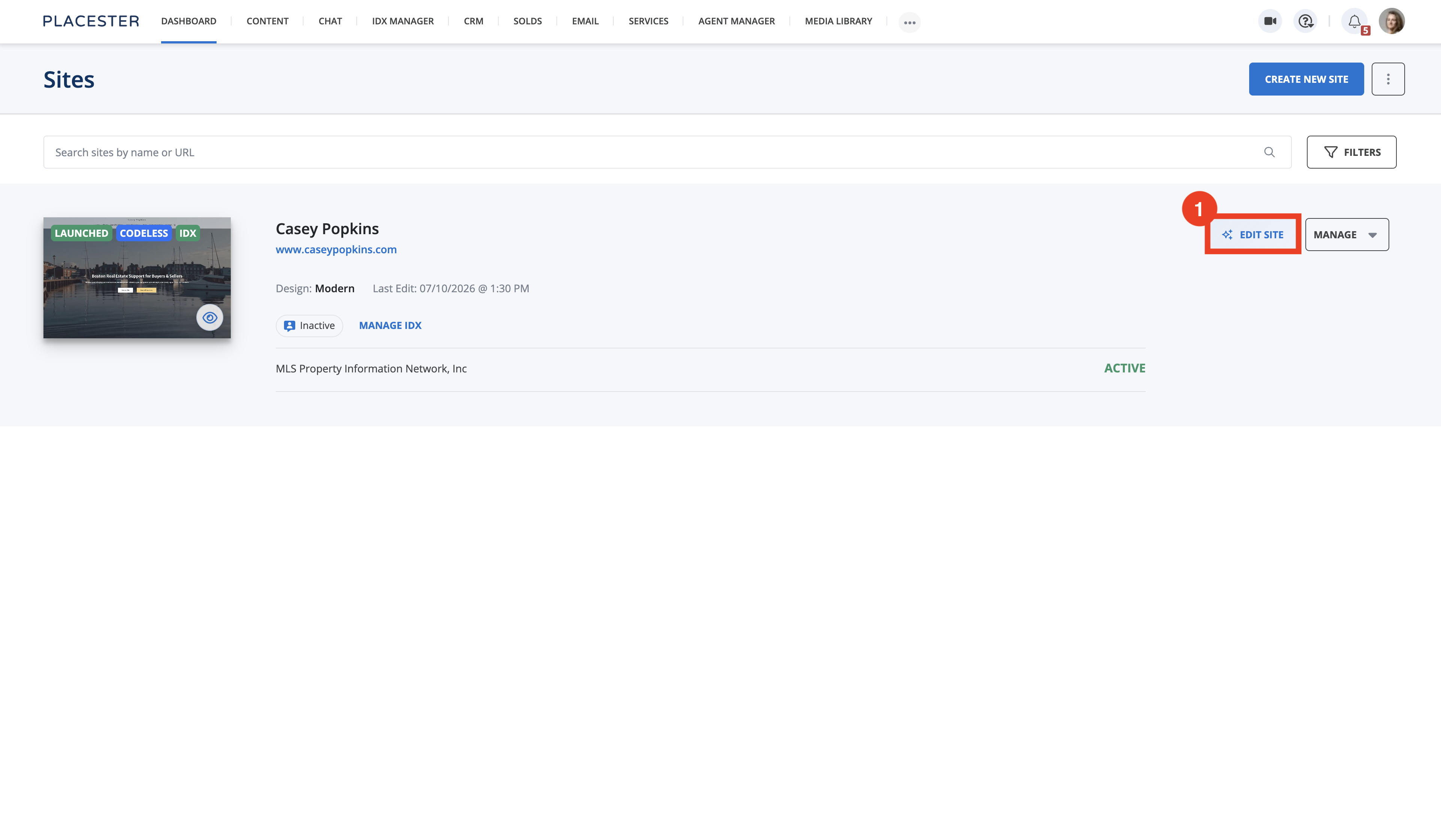
- Select Dashboard in the top menu.
- On the site card, select EDIT SITE. Site Edit opens with your homepage.
Open the page or post
- Use Pages or the preview navigation to open the content you want to optimize. For a blog post, select the Blog Posts filter in Pages, then open the post.
- Confirm the correct page or post is loaded in the preview.
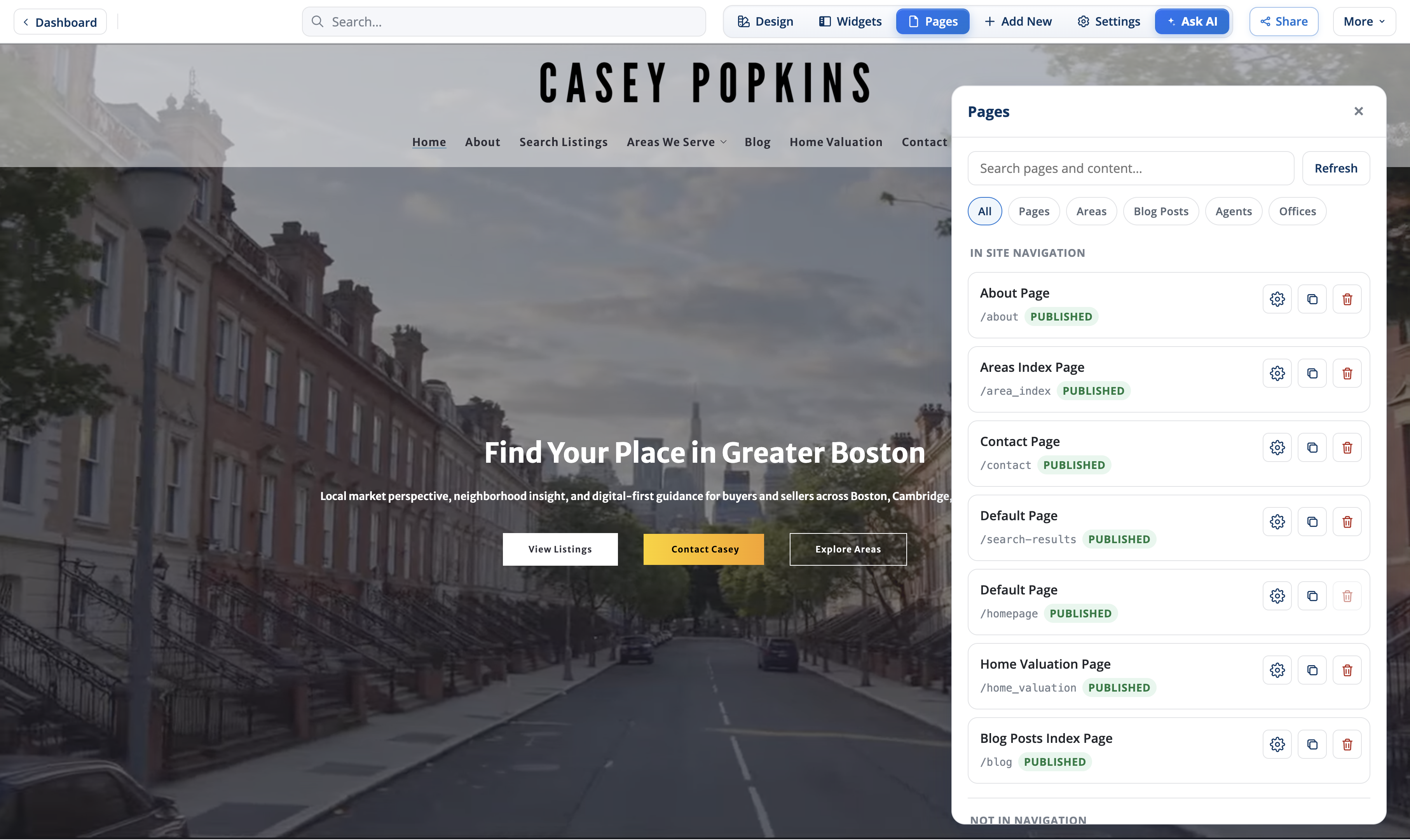
Settings always apply to whatever is currently shown in the preview, so it is worth confirming the right content is loaded before you start typing.
Open Settings
Select Settings in the toolbar.
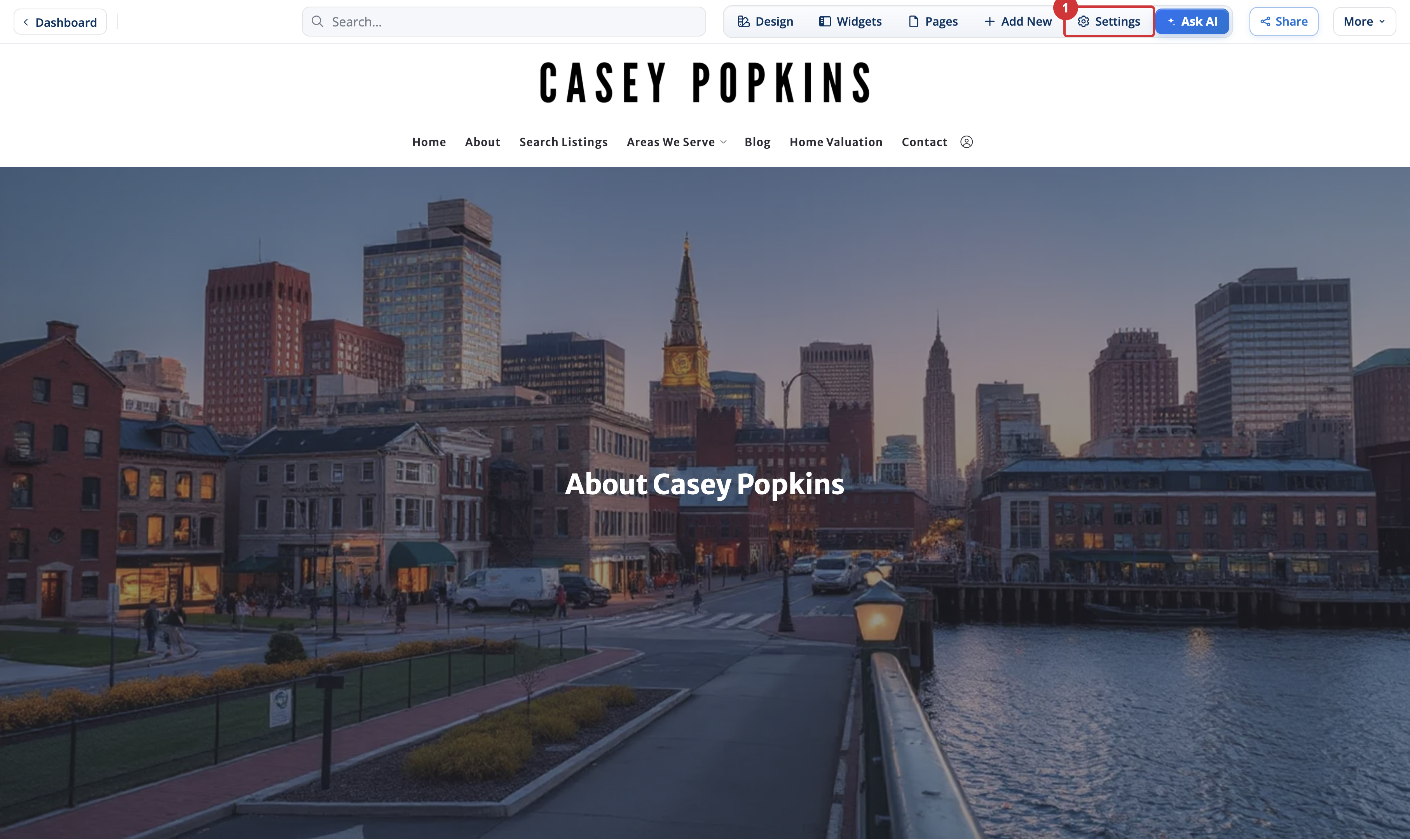
- Select Settings while the target page or post is in the preview.
Edit page SEO
For a page, open This Page → General:
- Turn on SEO settings if the SEO fields are collapsed.
- Edit Meta title.
- Edit Meta description.
- Optionally enable No index if the page should not appear in search results.
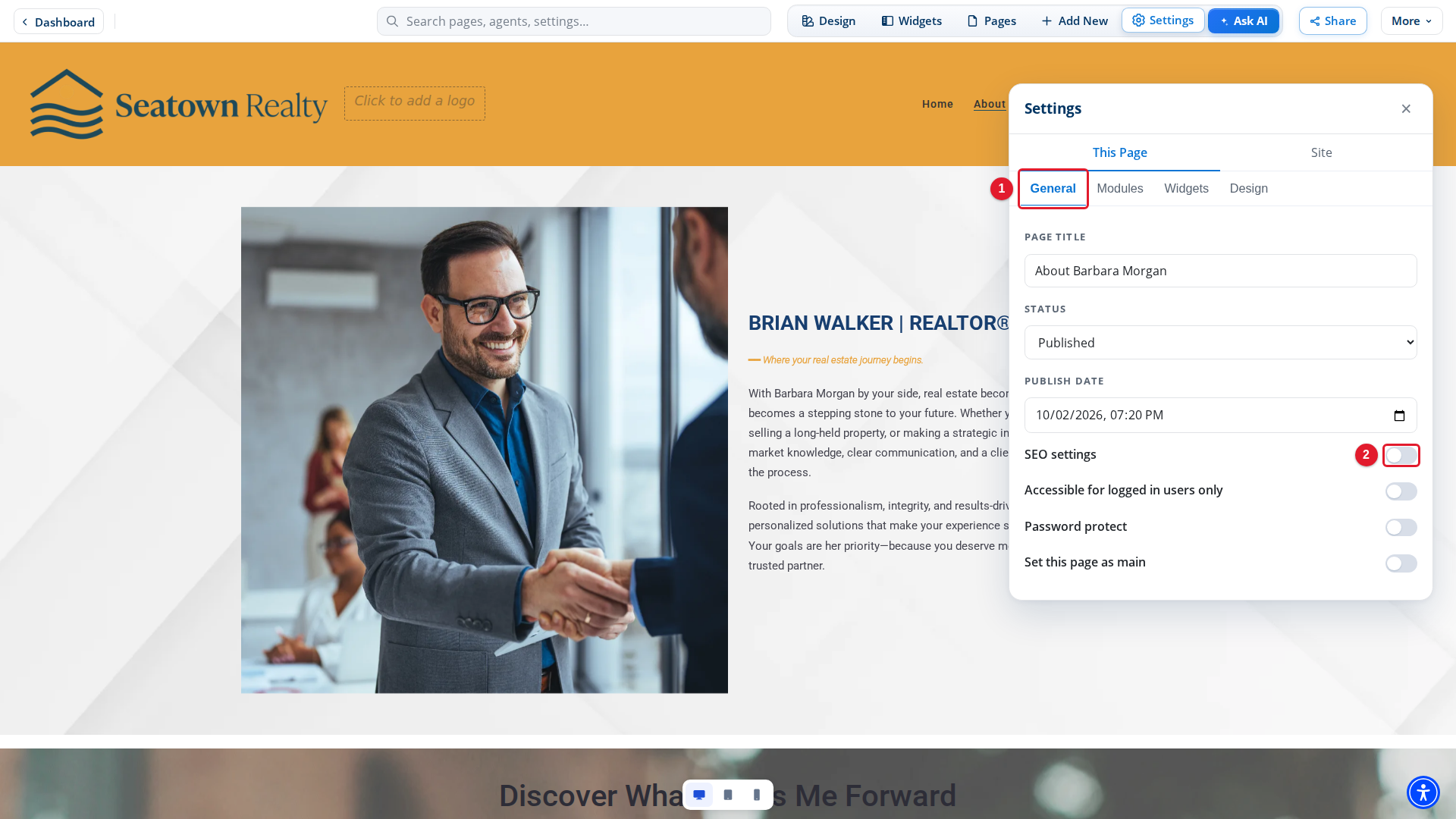
- General — includes SEO settings for the page.
- SEO settings — turn on to show Meta title, Meta description, and No index.
No index shows only when SEO settings is on. The General tab has no field for the web address of the page.
Edit blog post SEO
For a blog post, open This Blog Post → General and update:
- Turn on SEO SETTINGS if the SEO fields are hidden.
- Meta title
- Meta description
- Meta keywords
- Meta image (when you want a specific share image)
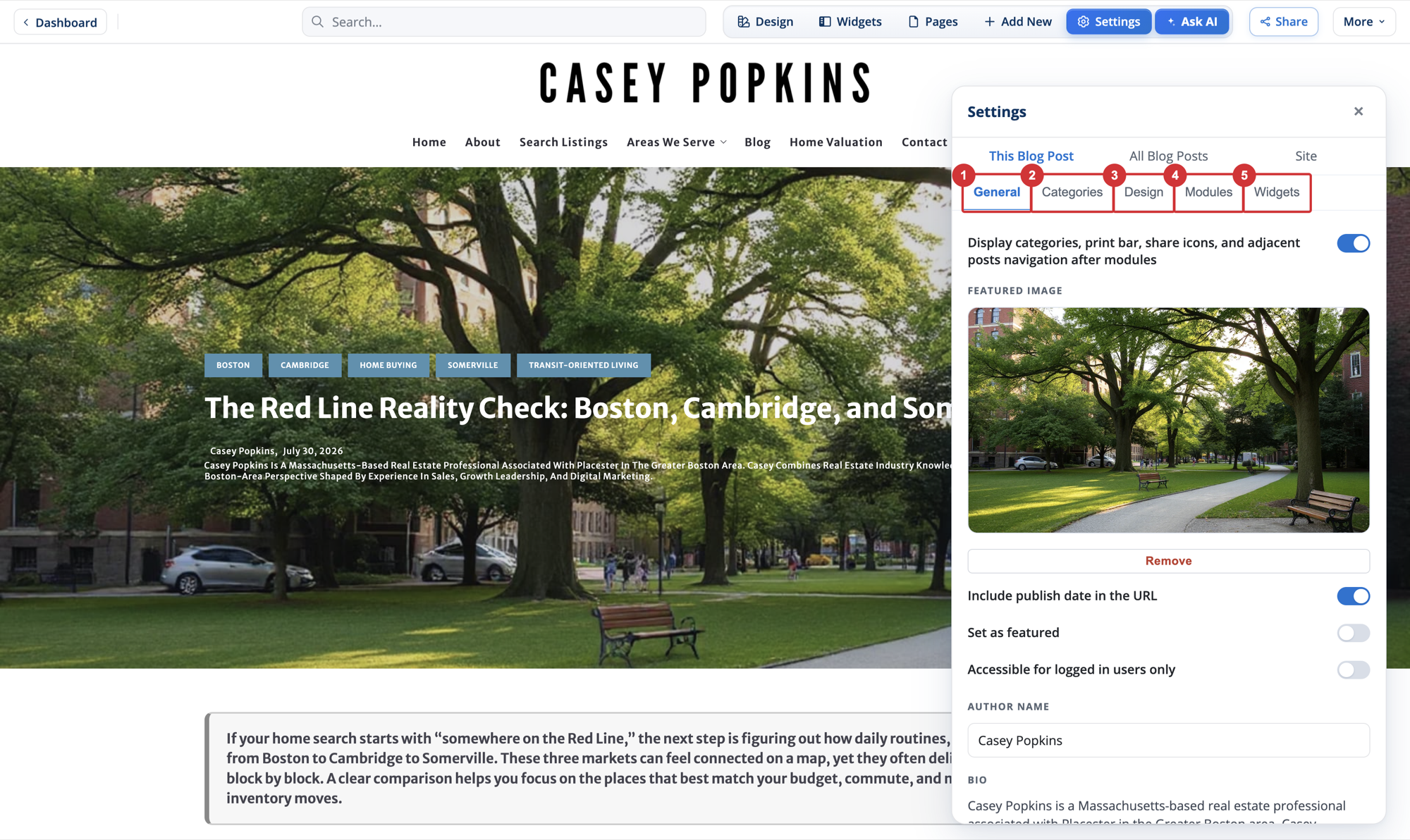
- General — includes meta fields for the post.
Posts have two extra fields that pages do not. Meta keywords records the topics the post covers. Meta image sets the picture that appears when someone shares the post — useful when the automatically chosen image is not the one you want representing the article.
Treat Meta keywords as stored descriptive metadata, not a ranking control. Major search engines do not use that field to improve a page's position in results.
Write meta titles and descriptions that work
Search engines decide for themselves how much of your text to show, and they sometimes rewrite it, so treat these fields as your best summary rather than something you can control character by character:
- Lead with what matters. Put the distinctive words first — the neighborhood, service, or topic — so the meaning survives if the end is trimmed.
- Keep each one unique. Give every page and post its own title and description instead of reusing one across the site.
- Describe the page, not the site. "Waterfront condos in Sarasota" tells a searcher more than a repeated brokerage name.
- Write for a person. A readable sentence performs better than a list of keywords strung together.
- Match the content. If the description promises something the page does not deliver, visitors leave again quickly.
- Front-load the description too. Use it to answer "why should I click this?" in the first phrase.
When to use No index
Turn on No index for pages you want live but not listed in search results — for example a thank-you page after a form submission, or a page you keep around for a specific link. It asks search engines not to include the page in their results; it does not restrict who can open the page. To limit access, use Accessible for logged in users only or Password protect on the same General tab instead.
Publish your changes
SEO edits are part of the Site Edit draft. Select PUBLISH to apply them, or DISCARD to remove unpublished changes.
Meta title and description affect how search engines and social shares describe the page. They are separate from the visible page title shown on the website.
Search engines re-crawl on their own schedule, so a published change can take a while to appear in results even though it is live on your site immediately.
For more about applying or removing pending changes, see Publishing and Discarding Drafts.
Need more help?
For questions, concerns, or feedback, chat with our team at app.placester.com/chat.
How did we do?
Choosing Which Listings Appear on Your Site
Showing Open Houses, Recent Sales and Coming-Soon Listings

Let experts do it for you
Visit our creative services marketplace to get on-demand help, on-time and on-budget.
Browse all Services
Are you looking for something different?
Didn't find an answer to your questions? Our support team is ready to help you.
